
 Series: The Saga Series #6
Release Date: 2024
Genre: Historical Fiction
Buy the Book:
My books are still available wide, but you’ll find the best prices on my store, especially if you buy more than one novel. Check out the two and three book Bundles here:
Libby's Store
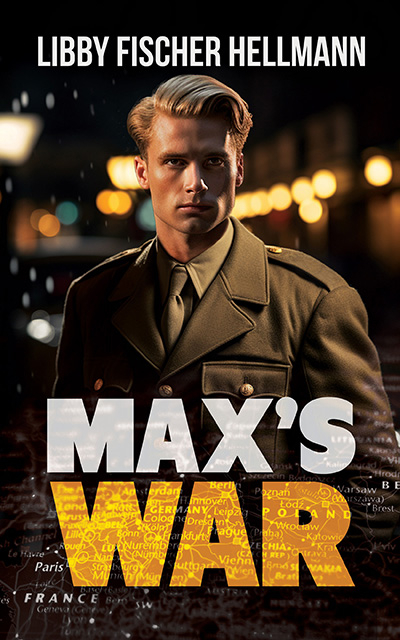
As the Nazis sweep across Europe, Jewish teen Max and his parents flee persecution in Germany for Holland, where Max finds friends and romance. But when Hitler invades in 1940, Max escapes to Chicago, leaving his parents and friends behind. When he learns of his parents’ murder in Sobibor, Max immediately enlists in the US Army. After basic training he is sent to Camp Ritchie, Maryland, where he is trained in interrogation and counterintelligence.
Deployed to the OSS, Max carries out dangerous missions in Occupied countries. He also interrogates German POWs, especially after D-Day and the Battle of the Bulge, where, despite life-threatening conditions, he elicits critical information about German troop movements.
Post-war, he works for the Americans in the German denazification program, bringing him back to his Bavarian childhood home of Regensburg. Though the city avoided large-scale destruction, the Jewish community was decimated. Max roams familiar yet strange streets, replaying memories of lives lost to unspeakable tragedy. While there, however, he reunites with someone from his past, who, like him, sought refuge abroad. Can they rebuild their lives… together?
This epic story about a Ritchie Boy is Libby Hellmann’s tribute to her late father-in-law who was active with the OSS and interrogated dozens of German POWs.
Reviews:
Hellmann expertly marries heaps of historical detail with a thoughtful illustration of the dangers of nationalism. This ranks with the author’s best work.
—Publishers Weekly
Intense and suspenseful… gripping… This thriller will resonate with history enthusiasts but also anyone seeking stories about standing up against hate.
—BookLife Reviews (Editor's Pick)
Meticulously, enviably researched, with an unerring eye for detail. It’s the 20th century at its worst, and it’s a story everyone should know, everyone should read.
—John Lawton, author of the Joe Wilderness series
Also in this series:




Excerpt:
December 1942
Camp Ritchie, Maryland
Max Steiner wanted to kill Nazis. He had reasons. The Nazis had killed the people he loved. They’d forced him to flee Germany, then, a few years later, Holland as well. Hitler had stolen his life. He was not—and would never be—like other twenty-two-year-old men.
It wasn’t always that way. He’d been a good-natured, bright, carefree boy. A boy who respected his parents, enjoyed his friends, and loved sports. Because of Hitler, however, he grew into a man who was plagued by uncertainty and fear. He anticipated the worst. He carried a rage he couldn’t tamp down.
But now everything would change. He was about to take control—control he’d wanted for years. He stood outside the gates of Camp Ritchie, tucked away in rural Maryland near the Pennsylvania border. After months of running, marching, doing push-ups, and learning to shoot in basic, someone realized his fluency in German and pulled him out of the group. He wasn’t quite sure why he was here or what he would be doing, but he hoped to take revenge on the Nazis.
If he looked toward the horizon, he had a view of Catoctin Mountain, part of the Blue Ridge and Appalachian chain. Snow dusted the evergreens and edged bare branches with thin ribbons of white. Max closed his eyes and breathed in deeply. He could almost imagine he was in the Black Forest. In the years since his family had fled Germany, Max had lived in urban settings: Amsterdam and Chicago. Now the chilled air was scented with a whiff of pine. It awakened a sense of longing for the greenery and thick forests of home. But that was not an option. He swallowed.
An MP checked his transit papers, opened the gate, and directed him to the main headquarters building, which resembled a small stone castle with symmetrical towers and parapets on each side. Unusual for a military base or camp, he thought. Max turned around to get his bearings. Although it was winter, active construction sites dotted the campsite. He wondered what they were building. He turned back to the main door and pulled it open.
He walked into a large room and gave his name to a clerk behind a counter, who picked up a phone and mumbled to someone. A moment later a uniformed man who looked older than Max came toward him from a row of offices at the back of the room.
“Private Steiner, I’m Lieutenant Bob Townsend. Welcome to Camp Ritchie. How was your trip?” Townsend was tall and skinny and wore reading glasses. His dark hair was wiry, and although it was morning, a five-o’clock shadow on his cheeks was visible. He extended his hand.
Max saluted. As a private first class, he did not expect to be greeted by an officer. “Good morning, sir.”
Townsend held up his palm. “You can dispense with that. We’re pretty informal around here.”
“Yes, sir.” Max lowered his hand.
“In fact, I think you’ll find this place is not like other military institutions.”
“Yes, sir,” Max replied without thinking. He stopped himself.
Townsend laughed, as if he knew exactly what Max was thinking. “I know. It takes some getting used to.”
Max felt his cheeks get hot. He wasn’t used someone reading his thoughts. Then the lieutenant did something that startled Max, once he realized what it was.
“We may not have been here a long time, but we think it’s a special place, and we expect you will too. Today you’ll meet our commander, General Charles Banfield, and his top officers.”
The general of the camp? What was this place? Officers didn’t associate with NCOs like Max. Was this some kind of test? But when Max heard Townsend switch to the American pronunciation of “Banfield” he realized something else, perhaps more important. The lieutenant had switched from English to German. With an accent Max hadn’t heard since he left Germany.
Max couldn’t help it—he gaped. He spoke German with his Chicago cousins, but when he heard a stranger in an official US military setting use his native language, with a local dialect no less, the emotional door he thought he’d nailed shut started to crack open.
Townsend smiled as if he knew the effect he was having on Max. “You’ll also meet Lieutenant Colonel Walter Benway, our second-in-command. And Colonel Davis, our director of training, maybe even Major Theodore Gresham, who created the program. Where in Germany did you grow up, Private?”
“Regensburg,” Max said in German, still off-balance.
Townsend nodded. “I know it well. I’m from Munich myself.”
“Practically around the corner,” Max said.
“You’ll find plenty of Germans here. Austrians too.” He paused. “You Jewish?”
Max nodded.
“Most of the Germans here are. It’s not home, but it’s—”
He was cut off by a shout in English from a nearby office with a closed door. “Get the fuck in here, Lieutenant.”
Max raised his eyebrows. Townsend grinned, went to the office, and opened the door.
“I’ve got Private Steiner here.” He ushered Max inside, then stepped out and closed the door.
Max gazed at the man behind the desk. He had a solid frame, beady eyes, a ruddy complexion, and ears that were too big for his face. His manner made Max think he was used to talking long and loud, and anyone who disagreed with him could go to hell. An open folder lay on his desk, and as the door closed, he looked up from it and studied Max.
“General Banfield, soldier. Good to meet you.”
Max saluted. Banfield nodded.
“Pull up that chair in the corner,” Banfield ordered.
Max complied.
Banfield opened a drawer behind his desk, withdrew a box of cigars, and took his time selecting, rolling, and lighting one. The pungent acrid smoke wafted over Max. “You smoke?”
He pointed his cigar at Max.
“No, sir.” He repressed the urge to clear his throat. His father had always told him to say he wasn’t “partial” to things he didn’t like. Cigar smoke was one of them.
“Don’t know what you’re missing.” Banfield puffed. “Probably for the best. More for me.” He chuckled. “How much do you know about Camp Ritchie, Private?”
“Practically nothing, General.”
Banfield nodded as though he’d expected Max to say that. “Good.” He puffed again on his cigar. “You have been selected to join the first ever US Army Intelligence training program. You are inside the Military Intelligence Training Center. MITC. But that’s classified. You can never divulge the name or where we are. Never. Got that?” A stern look came into his eyes.
Max nodded.
Banfield’s expression relaxed. “Over the next couple of months you’ll undergo intense training in a number of areas that will prepare you to go back to Europe and help end this goddamned war.” He cleared his throat. “Ostensibly your job will be to interrogate German POWs, pry out German troop movements and as much intel as possible about their military strategy. Which you will then summarize in a report and send up the line of command.”
Banfield exhaled, dispatching a cloud of smoke and the odor that went with it. “But that’s only part of your mission. You will also be trained in counterintelligence by our friends in the OSS. What you learn will equip you to be flexible, to improvise if need be, but to succeed in whatever you are tasked with. Wherever you are.” He paused again. “You get what I’m saying?”
Max’s pulse quickened. Banfield was keeping the conversation intentionally vague, but Max guessed he would be sent on specific missions to prevent German advances. Or keep them from getting Allied intel. A mix of pride, excitement, and fear washed over Max. It was as if his life to date had pointed him to this place. This time. This was exactly what he was supposed to do.